There’s a saying that goes opinions are like assholes: everyone has one. Maybe it’s a bit of a stretch to say that everyone who runs has a goal… but that’s my opinion, and I don’t think it’s that far off.
If you run with a goal, great.
If you run without one, then your goal is exactly that—not having one—and that’s great too.
Looking for a simple definition of a goal, I found the following in the literature: “what an individual is trying to accomplish; the object or aim of an action” (Locke, Shaw, Saari, & Latham, 1981, p. 126), and “to attain a specific level of proficiency, usually within a specified time limit” (Locke & Latham, 2002, p. 705).
In my case, ever since I laced up my trainers in April 2019, my goal has been to break 1:24 in the half marathon.
Science backs this up — and I’m not just saying it because it sounds good. Setting goals is one of the most powerful drivers of personal development. Challenging goals lead to higher performance than easy goals, having no goals at all, or vague “do your best” goals (Latham, 2009).
My personal best in the half marathon was 1:40, so for me, 1:24 already felt hugely ambitious. Could I have aimed higher? I doubt it. But the biggest lesson running has taught me isn’t the time you hit. The real challenge isn’t starting to run—it’s keeping it going, day after day, month after month, year after year.
And it’s not just me saying it: consistency is the biggest barrier for most runners (Franken, Bekhuis & Tolsma, 2022).
In my case, intrinsic motivation has been key: I wanted to run fast, feel strong, and feel good in my body. Self-Determination Theory (Ryan & Deci, 2000; 2017) explains that when we run for internal reasons—enjoyment, personal growth, or wellbeing—we’re more likely to stick with the habit long-term.
When there are no clear goals, that intrinsic motivation fades; we lose touch with our values and with the “why” behind our running. The literature backs this up: a lack of clear goals is one of the main barriers, along with low self-esteem, fear, or a lack of social support (Collazo-Castiñeira et al., 2025).
Interestingly, my biggest motivation slumps have come right after hitting a goal. I’m not the only one—many runners say the same.
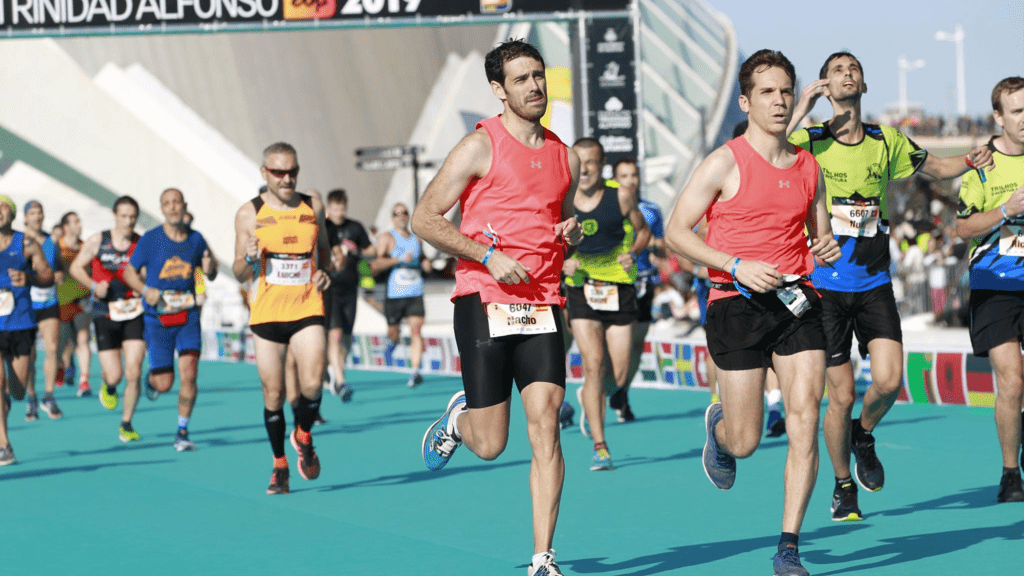
This year, I stopped the clock in Getafe at 1:24:48. You could say goal achieved. And yet, for a few weeks I felt unmotivated… until I set the next challenge: Valencia at the end of the year, trying to shave seconds—maybe even minutes—off my personal best.
That’s where Buddy Pacer can help. Not every day we know exactly what we’re aiming for—and that’s okay. But having a daily training goal, even a small one, helps keep motivation up.
If you already have a goal, share it. If you don’t, join another runner’s goal that fits your schedule, pace, and location. Sometimes the best goal is simply not running alone.